Johannes Punkt’s Flaskpost

You may be required to show proof of id.

Category: Writing

NORTH OF REALITY TRANSLATION PROJECT: FOUND FOOTAGE

Good deep dark night, friends. Today’s piece is Found Footage. Translation notes, in English, are found below the story. All entries in the project so far are found here: /tag/the-north-of-reality-translation-project/

~

NORR OM VERKLIGHETEN: UPPHITTAD FILM
    av Uel Aramchek
        översättning: Johannes Punkt

Du har kommit till den här skogen för att leta efter varelsen som kallas ”sasquatch.” Vid det här laget har du fått reda på att han är mänsklig; åtminstone om man inte är så strikt med sin definition av ordet ”mänsklig.” Hans kött har förvridit sig från åratal av lång exponering och hans hud har suddats ut till skenpareidolisk ull. Ett groteskt tumavtryck kvarstår där det en gång må ha funnits ett ansikte, utan att kunna se eller prata.

De flesta resenärer anländer till Kanal Noll Nationalpark av misstag men du har tagit dig hit med flit. Denna plats har fötts fram ur videofeedback; träden här dryper med resterna av nattkikares limegröna glöd. Du trycker din hand mot den självlysande barken på en urgammal björk och den glider rakt igenom. Du drar tillbaks handen och dina fingrar är genomdränkta med brusande TV-sav, alldeles bortdomnade.

Stundom hörs omgivningens vita brus högre än vinden genom löven.

Somliga säger att människan har frammanat denna plats, en knut i rymdväven som fötts fram ur avståndet mellan lins och spegel. Andra säger att det är ett urtidsrike, lika gammalt som spegelbilderna av träd i Minnesotas sjöar, och att mänsklig inblandning bara har tjänat till att skynda på en urgammal process.

Du har följt hans spår mil efter mil, bara för att anlända till en gravhög. Det finns dock ingen höjd jord här; bara en massa kameror och mjukt flimrande ben. ”HÄR VILAR SASQUATCH,” står det på en minnestavla av järn vid högens fot. ”DÖMD TILL MYT, DRÄPT AV FÖRNUFT.”

Trots det markerar denna milstolpe slutet på din egen resa, för hans spegelbild har följt dig hela vägen hit. Ditt sista minne är hur du bländas av din egen blixt; kanske kommer någon, någon dag, att framkalla bilderna.

~

Notes

I did not know of the equivalent term for “found footage” when I started this translation, but fortunately the particular genre of horror film that shares this name is a well-blooming genre, and even though Swedes would mostly just say “found footage” when talking about the genre, the translation is unconfusing and understandable. There’s an interesting gradient of loan words being assimilated into the language, from words pronounced with a mouth still in foreign mode to words pronounced like they have always been part of the language.

What I mean by this is, well, take your American English language vowel chart. Uel’s accent looks something like this, by my reckoning:

a hand-drawn vowel chart.

That’s the place of all the vowels in the mouth. The consonants also have their places, but it would look too crowded if I included them too. And trust me, this is definitely how sounds work. Actually, don’t take my word for it, but take it up with tongueistics if you’ve got a problem.

Anyway, see how the vowels all keep some respectable distance between each other? In different languages, the sounds are in different places (and there’re different amounts of vowels! A language with a small number of vowels will have much wider berths than a jam-packed one). Switching to another tongue is very literally like switching to another tongue, one with other settings. So for a loan word like “found footage” we would switch very quickly to English for the duration of that word, then back to Swedish. For a word like “tight,” which is /taɪt/ in IPA (the International Phonetic Alphabet) we would not switch, but say /taɪt/ but with the Swedish placement of those symbols instead. And then there are phrases that are undergoing this assimilation but aren’t there yet, such as “slow-motion,” which is a bit all over the map when I say it in Swedish at least. You can figure out pretty well how long ago a loan word was loaned in by judging how far along this process the word is.

I figured that Sasquatch, having had an episode or two in the X-Files, is well-known enough in Sweden that I need not intervene as a middle-man narrator and explain anything about him. The name, in Swedish, is obviously foreign because of the letter combinations, but I think it’s pronounced with a tongue halfway between English and Swedish. Like we don’t know what to do with the sounds. It’s not an exact science, this. It doesn’t help that it’s a name from another language than English, either.

That became a large tangent. That’s okay. Next let’s look at something else in the first paragraph: the word pareidoliac. Uel has made a smooth neologism, making pareidolia (the tendency of humans to find patterns in random noise) sound like an affliction akin to insomnia (cf. insomniac). This structure is sadly not mirrored in Swedish, so I had to work around it to get a somewhat similar effect. My idea here came from the prefix sken-, which literally seems to mean “shine” and is used to mean something like “false” or “mock,” as in skendränkning (“mock drowning”) or skenfrukt (“false fruit”). I tend to think of it as fae glamour or something, although I’ll admit to not knowing the deeper etymology here.

This story is all about things becoming what they seem, and surface levels affecting the deeper levels, so I made up the word skenpareidolisk, to vaguely suggest that maybe the pareidolia is false. In what way it is false is for the reader to fill in although I made sure to figure out at least two ways, in case someone corners me and demands an explanation for the freedoms I’ve taken in the translation. Which is all to say that when it comes to translating a style you have to keep the language breathing, in my earnest opinion.

Chartreuse is not a word, not a colour, in most people’s Swedish. So I picked lime instead. That colour is right in the same part of the spectrum, just shifted a little bit. It’s difficult to get the auras of colours right because colours are one of the most direct forms of symbolism (in art as well as in nature: you instinctively don’t want to eat something wild coloured black and red and yellow! Wow we’re all about the tangents here). Translators between languages less intermingled than Swedish-English have to deal with various issues like blue and green being the same colour, or light blue being as different from dark blue as pink is from red. But fortunately Swedes and Americans have the same images of such binoctulars as Uel describes, so I’m resting my translation on that shared bit of culture and hope that the description simply makes the reader recall the right chartreuse hue.

Turns out that we have “landmark” in Swedish (“landmärke”) but that it is a nautical term, and while we’ve also got it as a calque for the non-nautical use, the more commonly used word for this type of memorable abberration in the landscape is milstolpe (“milestone”), from an extension of the word’s literal meaning.

~

I didn’t actually sit down to chart Uel’s accent with linguoscopy, but wouldn’t that have been super cool and a bit creepy? The image is just roughly what a southern Californian accent is like, according to a chart I saw on Wikipedia.
NORTH OF REALITY TRANSLATION PROJECT: A WRONG TURN AT ALBUQUERQUE

Good evening! You’re looking great today. Did something happen to your hair?

Today: A Wrong Turn at Albuquerque. Translation notes, in English, are found below the story as usual. You can find all entries at the following link, except for the entries that are still to be posted: /tag/the-north-of-reality-translation-project/

~

NORR OM VERKLIGHETEN: EN FELSVÄNG VID ALBUQUERQUE
    av Uel Aramchek
        översättning: Johannes Punkt

~

Du kommer ihåg Utah, och hur bergen speglades i saltöknens bleka spegel, och hur saltöknen speglades i himlens bleka spegel, och hur motorvägen, utan någon annanstans att ta vägen, speglades in emot sig själv. Du kommer ihåg avfarten mot den ensamma sträckan av tjära och betong som var motorväg I13 på väg mot Reno, du var sömnlös och ökenhalstrad och du såg din egen puls i ögonvrån.

Du kommer ihåg Nevada, och hur vägen som tidigare verkat rak egentligen hade varit en lång spiral, och hur allt neon i Reno rödskiftade iväg från dig när du ändlöst närmade dig, och hur det till slut inte fanns något annat val än att vända omkring. Du kommer ihåg att I13 på något vänster virvlade inåt i båda riktningarna, och att solnedgången framför dig också var synlig i backspegeln.

Du kommer ihåg Mazo, och hur de naturligt förekommande radiotornens blodstensmalmspännverk kastade långa skuggor över den månstekta jorden, och hur jordandarnas klagosång överröstade din bils ljudanläggning på varje frekvens, och hur svultna stäpplöpare stannade till för att frossa på överkörda djur. Du kommer ihåg den oerhörda törsten som fick dig att pröva att svälja en näve vattenpuder.

Du kommer ihåg New Mexico, och hur underligt det var att byggnaderna i Albuquerque inte hade några fönster, och hur dess gator inte hade några fotgängare. Du kommer ihåg att du stannade till vid Hotel California vid utkanten av staden bara för att få reda på att de inte hade några lediga rum, och hur utsökt festmåltiden såg ut där den hade dukats upp inne på atriumgården. Du kommer ihåg hur ditt fordon sprang iväg med en flock vilda bilar och lämnade dig att dö.

Du kommer ihåg liftandet längsmed I13 och längre in, och hur en långtradarchaffis plockade upp dig i Bolgana, och hur du var så törstig att till och med råoljecidern han erbjöd dig smakade himmelskt. Du kommer ihåg hur han förklarade för dig att världens ände brukade vara en fysisk plats ingen kunde ta sig till, och hur det sedan dess hade blivit ett datum i framtiden ingen kunde nämna. Du kommer ihåg när polisen stannade honom för fortkörning och arresterade honom när det uppdagades att han egentligen var en hägring.

Du kommer ihåg allt det här medan du står vänd mot Amerikas innersta gräns. Du sitter på en farligt långt utstickande sten över en bottenlös krater. Här tar kraftledningarna som under hela din resa kantat vägen slut; de sista kilometrarna av deras längd har flätats runt sex massiva stämskruvar. Nu när du hittat världens ände är det bara att vänta.

~

Notes

A thing they won’t tell you at fancy translation schools, but which I will tell you right now, is that sometimes translating a title of a piece will involve fruitless hours of trying to find Swedish clips of Bugs Bunny on the youtubes. As fate would have it, the Swedish Wikipedia page for Bugs Bunny assures me that the “left turn at Albuquerque” gag has been translated into “Jag borde ha svängt vänster vid Södertälje” at least once. Now the question stands: what’s the proper translation technique here? Obviously I cannot remove the Americaneousness of this quintessentially American road trip story. I didn’t need any of the extra information about Bugs Bunny or anything – a direct translation is the best option here. Very well.

I’ve probably mentioned it before – like, last week for example – but a frustration that occurs in translation is when two different words in the source language are translated into the same word in the target language. This time, both “road” and “somewhere to go” have individual translations that work best with “väg,” and I am initially averse to repeating that word. However, it only seems odd to repeat it if you have stared at it as long as I have, and initially you will not (might not, will hopeuflly not) notice anything’s amiss. I just wrote “the road” as “motorvägen” (the highway) and it does look seamless, I’d say.

For similar but opposite reasons, near the end of the story, I’ve translated “the highway” as simply “vägen” instead of its more specific cousin. Clarity and smoothness help the equilibrium the most.

On a related note, the anaphora in this piece is slightly tricky to translate, because of grammar. The “You remember” bit is easy, but in English you can follow it with a noun (as with the State names) or a dependent clause in the progressive (-ing, as in hitchhiking), no problem. The progressive doesn’t really exist in Swedish and its equivalent is not as ubiquitous. I could translate the penultimate paragraph’s progressive clause as something that means and looks like “You remember how you hitchhiked,” but the clause would lose its nounness and I’d be sad. The solution, I figured, was to make it a full noun. The present participle is a thing in Swedish, and you can noun things with it. This seems like a lot of justification for translating a present-participle word into a present-participle word. But the jump from verb to noun is huge, to the point that if you compare the onset of those sentences it looks wrongly translated. A strange effect, and one I have to remind myself of both as a reader and a writer/translator: that things that seem wrong on the detail level make the whole thing work on the holistic level.

~

The bit about the shifting dimensional idea of what the end of the world is is probably my favourite line of Uel’s ever.

The Poet Realizes Almost Too Late that his Advice is Not Wanted

or, The First Three Stanzas

Your heart strings your heartstrings all up in your living-tomb

and last week will last. We could stay. (We should give him room.)

Your organs will begin to rot inside

your skin, you butterfly in progress. Bide

your time for years until you are a corpse,

a living Buddha. Dead. Forgotten. Here,

you see that you’re not getting any where.

I have a poem in my chest tonight.

I know you. You won’t act your best tonight.

We’re broke and we’re broken; we’re blacklight and virgin vein.

Dim lights, pills, your light spills like mist and a purging rain.

You’re shaking like a leaf, you tremble like

a trigger finger, drink pressed like a mic

against your lips, you’re always in a kiss,

you frog, you scorpion. You shouldn’t know

how many people you’re in love with, though.

I have a poem in my throat tonight

and you will let me have your coat tonight.

I meet her and meet her high standards or what-have-you

and so far I’m so far away from you. Not a clue.

And she’s not evil, no-one is, but still.

But still. But still, you flee to your Brazil

committing crimes just to get in, but you,

you kicked chihuahua, don’t belong in hell

or heaven, you belong right here. We tell

ourselves we’re poems, but you cannot fit

a sonnet in a koan, but still: you suck

the marrow out of life itself to fuck

your spine up, crush your bones. And if you let

it go, this poem in between my teeth,

I’ll teach you how to breathe, I’ll stand beneath

and catch you, should you fall, this ending you

can’t help. For we take turns, my friends and I

to be the one to say: today, don’t die.

I have a poem on my tongue tonight

which I have swallowed. I have sung tonight.

~

From the hidden archives. Offered up today as a prayer that I won’t have to write another one of these.

NORTH OF REALITY TRANSLATION PROJECT: WAYFINDER

Good $TIME. I am so $EMOTION to see you. Take a $SEAT, and welcome to the North of Reality Translation Project! Today’s special offer is Wayfinder, with a side of translation notes and language/culture musings in English. But our menu is well stocked with other courses: /tag/the-north-of-reality-translation-project/

~

NORR OM VERKLIGHETEN: DEN SOM FINNER VÄGEN
    av Uel Aramchek
        översättning: Johannes Punkt

Under en synnerligen lång vinter började labyrinter bryta ut i metropolen som en infrastrukturell sjukdom. Varje natt vävde sig gränder in genom varandra och formade tjocka betongknutar som blandades med tunnelbanelinjer och fallfärdiga telegraftunnlar. Tegel och glasfiber vreds till vilda helixar och motorvägar ömsade sina skinn likt ormar för att komplicera härvan. I dagsljus återstod inga bevis av dessa rovlabyrinter, förutom de tillfrysta kropparna som lämnats kvar av de som snärjts in inuti dem.

Till slut spreds legender, inte bara om dessa mörka utrymmen men även om den som kunde leda vilse själar ut ur dessa urbana grottor. Hon sades hölja sig i paisleymönstrad midnattsskrud, upplyst av vad som verkade vara hennes eget blod. I sin högra hand bar hon sitt eget självlysande hjärta som en lanterna, en pulserande tacka gjord på gyllene muskler som tjudrats till hennes bröst medelst en ansamling tjocka kablar. Det dröp här och var som hon vandrade och lämnade ett spår av plasma som andra kunde följa i säkerhet.

De som påstod sig ha blivit uteskorterade ur labyrinten av henne säger också att hon inget namn gav mer än ”Den som finner vägen” och konverserade knappast mer än att hon insisterade på att de skulle lita på hennes omdöme. Däremot ryktades det fritt om hennes ursprung. Det förmodades att labyrinten svalde henne levande en olycksalig afton, men att hon lyckades överleva pärsen och kravla i säkerhet genom dess trådar, fast hennes anatomiska struktur förändrades permanent. ”En gatlykta hällde tillbaks henne i vår värld likt en kran,” säger en variant av berättelsen. ”Hon dog den kvällen, och återföddes som en del av staden själv.”

Andra är mindre övertygade av denna tolkning. ”Den här staden har aldrig varit på mänsklighetens sida,” förklarade en vagabond som tröttnat på den här versionen. “Stålet, glaset, fan, till och med skräpet … det trängtar efter att förtära oss. De där fantomgatorna hon vandrar igenom är stadens inälvor. Nej, hon är inte del av staden alls; hon försöker skydda oss från den.”

~

Notes

I had problems finding a good title for this. The very ideal would be a neat and compact composite noun like “Wayfinder” but the immediate solution – “Vägfinnare” – sounds daft as all hell. I was stumped for a long while and then I decided to go with a longer thing: “The one who finds the way.” It sounds equally mystical, but from another angle, and the namelessness of the name is enhanced.

Half-relatedly, in the time period in which I grew up, they stopped translating movie titles into Swedish. The effects of knowing some movies by their Swedish title because they were made before the tide turned is baffling, a bit like being from a parallel universe. Generally, the translators of movie titles were gentle and caring: classics like Some Like It Hot got translations based around the key title words (“hot,” in this case), while others were just translated literally to no fuss, like The Birds, or kept as they were because the title was not a translatable word as such, such as Casablanca. However. Things got weird, probably because of comedies. National Lampoon’s Vacation, which for some reason is considered a classic, was translated as Ett päron till farsa – “A pear for a dad.” The word for pear is slang for “parent,” I suppose, but if there’s more meaning to it than that it is lost to time (read: I don’t feel it will be enlightening to look it up, so suck it). Mel Brooks’ The Producers was translated as Det våras för Hitler, the name of the musical in the film, Springtime for Hitler. This is a bit weird, but okay: it is more eye-grabbing than “Producenterna.” Then The Twelve Chairs came, with a translated title we can back-translate into “Springtime for Mother-in-Law.” Then Blazing Saddles: Springtime for the Sheriff. Young Frankenstein: Springtime for Frankenstein. Springtime for the Silent Movie. Springtime for the Nutjobs. Springtime for World History. Springtime for World Space. World … Space? Probably that movie is what made the bubble burst, I feel. The title of Men in Tights was translated word for word, like picking up broken pieces of porcelain after one has failed an almost amazing trick using just a tablecloth and some fine china.

What were we talking about? Ah, yes, literary translation. For this piece I also encountered problems trying to translate “civic.” As it’s used and translated, it mostly refers to the human part of a city, or a population, but here that was clearly not the case, referring instead to the infrastructural schematics of streets in a city. After a few weeks of trying to climb this wall I realized that in my describing the problem I had used the perfect word for translating it – infrastructural – and just as quickly dismissed it for whatever reason. So, that was silly of me.

For some reason the phrase “to safety,” which appears twice in the text, stumped me. The correct way to say it is, unless I’m mistaken, “i säkerhet” (lit. “in safety;” but that’s very literal). Further proof that no-one should ever trust prepositions in any language. I always mess prepositions up no matter what language I’m speaking.

I feel like I’ve used the word “självlysande” for like fifteen different Aramchekian adjectives at this point. It’s actually just two – luminous and phosphorescent – but what would I do if these adjectives showed up in the same story? I’d have to use a fancy word like “fluorescerande” (fluorescent) for the phosphorescence. Which is not a word I’d really use otherwise. It’s all about the equilibrium, though, as always. This same problem actually comes up sprite-swapped in the translation of “interpretation” and “rendition,” both of which very squarely become tolkning. “Rendition” can also be version, fortunately. Although this becomes a problem when you consider that I had translated “version” in the paragrpah above simply into the Swedish “version” (imagine that I’m pronouncing these words different, since they’re spelled the same). So I changed that into “variant,” which probably is a nicer word there anyway. Solved.

Lastly, the word “ichor” is a nice word. Its roots in Greek and the mythology that it drags with it make it impossible to really translate as such, since translation is often root transplantation. (This metaphor might make more sense if you consider the roots of “translate” – trans meaning roughly “across [a border]” and late coming from something meaning “carry,” so “translate” = to carry from one place to another. We are carrying from English to Swedish here; when a word is too firmly rooted in Greek we have to use the same word in the translation. Like when you have a character talking Spanish in an otherwise English book, you would keep the Spanish, not carry it over to French or something (It’s a different story if we were to translate that into Spanish BUT that’s not my problem, so suck it (Again.).).)

So we have two options: deracinate or neologise, essentially. We do kind of have “ikor” in Swedish, in that I’ve seen it in at least one place and used it in at least one story myself, but my dictionary renders it as “gudablod” (gods’ blood) or “blodserum,” “blodserum, blodvatten” (blood serum, blood water) and googling for “ikor” only gives me obscure texts. If we deracinate it, we might instead talk of ectoplasm or just plasma. I am partial to the plasma and don’t think that the ichor has a very central role here, so I’m pulling out its roots to tend the garden.

~

It’s actually really easy to get sick of that word, “ichor” – you just have to overeat yourself on H. P. Lovecraft. I remember when I read Lovecraft I kept a tally of his favourite words. I was adolescently holed up in a Czech hotel with nothing to read but a werewolf glamour book that took a few hours to plow through and the whole Necronomicon collection, which I had conked all the way there. I remember most of them now. Squalid. Indescribable. Ichor. Could have sworn I remembered more of them. It’s been enough years now that I can speak them without bile, but it was touch and go for a while. Thank you for reading The Teenage Literary Review; next week maybe I’ll tell you about The Little Prince by Niccolò Machiavelli.

I Fed the Birds

The day you disappeared, I fed the birds:
I feared the pigeons would get bored and go.
My fears were realised, in other words.

So I cut up the calendar in thirds.
It’s bright, you’re here. It’s rain, you’re not. It’s snow,
the day you disappeared. I fed the birds

a mixture of unspokens and unheards.
Our cockatiels still bear your accent, though:
my fears were realised in other words.

I deal in unexpecteds and absurds
but never thought you’d break a promise. So
the day you disappeared I fed the birds.

An empty pasture save the ducks, those herds
I shepherd with my trail of crumbs. But no –
my fears were realised in other words.

I hid the end in shakens and in stirreds.
It’s always been like that; the things we know
(the day you disappeared I fed the birds
my fears) were realised in other words.

~

A collaboration with Richard Kirby (@_L_M_C_). I wrote the first line and he wrote the third line, and then we each wrote a villanelle with that as the skeleton. You can read his poem here: /status/738698600990027776

NORTH OF REALITY TRANSLATION PROJECT: THE DEATH-PAINTED PLANET

Good evening, good evening, good evening. Welcome to the North of Reality Translation Project, wherein I translate some of Uel Aramchek’s stories into Swedish but comment on it in English so that most of you can read and enjoy and understand despite not speaking Swedish. Today’s story is The Death-Painted Planet. You can find all of the posts in this project over at this link: /tag/the-north-of-reality-translation-project/

~

NORR OM VERKLIGHETEN: PLANETEN SOM PENSLATS MED DÖD
    av Uel Aramchek
        översättning: Johannes Punkt

Löpelden kan ses från rymden: en ständigt brinnande halvring som kopplar ihop planetens poler. Till öst om denna självlysande meridian glöder världen violett med liv; till väst finns dock inget annat att se än rök och öken, ett maskhärskat landskap. Flammornas flera jordmånader långa lopp ger fälten precis tillräckligt mycket tid att växa tillbaka. Satelliter i omloppsbana runt ekvatorn kan se hela livs- och dödsförloppet i ett enda varv, från jord till aska och åter till jord.

De första hovarna av vad som kommit att kallas Den eviga vildflykten kan höras bara ett par kilometer öster om eldfronten. Denna världs djur tillbringar sina liv på flykt, dundrande och fladdrande och slingrande sig ständigt österut. De betar kvickt och kort när de kan, och de som ännu inte har utvecklat förmågan att leva utan sömn rider på varandras ryggar. Långa snablar och klängen släpas bakom deras kroppar för att sörpla upp vatten och mossa och undervegetation. Det finns även rovdjur på en sådan plats, mäktiga varelser med mångtandade lemmar som låter dem släpa eller bära sina byten med sig medan de rusar framåt.

Ett expeditionsteam av astrozoologer gjorde en enastående upptäckt medan de observerade den skenande massförflyttningen ifrån deras gyrokopter: en liten stam nakna människor som sprang vid sidan av en flock segelrenar. Det visade sig att de var den överlevande besättningen från ett fraktskepp som krashlandat på planetens yta nästan tio år tidigare, och att de tvingats anpassa sig efter den ständigt förflyttande biosfären. De hade inget materiel kvar från sina stjärnsmugglardagar, för vad de än burit med sig en gång i tiden hade nu trampats eller bränts bort, inklusive deras nödsändare. De hade lyckats anpassa sig och överleva mot ofattbara odds genom att jaga i flock och bli vänner med några av de större bestarna för att sova på deras ryggar om natten.

Trots att överlevarnas beskrivningar av denna upplevelse var mardrömslika har många människor sedan dess självmant valt att springa med Den eviga vildflykten, och många fler tränar och tar supplement för att jaga detta mål. Somliga väljer det som en personlig fysisk utmaning, somliga gör det för att de inte har någonting kvar att förlora, andra söker upplysning genom att uppoffra alla personliga ägodelar. Den fysiska uthålligheten som krävs är enastående, men kanske inte lika mycket som den mentala. För de flesta av den räddade besättningen på det olycksdrabbade skeppet fortsätter flammorna jaga dem i drömmen, och att sitta still i mer än ett par timmar är att ge vika för vansinnet.

~

Notes

The word for wildfire in Swedish is perfect for this story: löpeld, formed from the roots of words meaning “sprint” and “fire.” On that note, I was a little bit worried that the two rotations in the first paragraph would lose their connection to each other in translation, but I ran with the theme and connected them both to running laps (lopp), and that was preservation enough. (A good rule of thumb when translating is that if two parts seem connected by word choice, they should seem roughly equally connected in translation.)

At the end of the first paragraph, we get a simple smooth reference to a Biblical phrase in the English. (I looked it up and a Christian website did say that although “ashes to ashes, dust to dust” is not in the Bible per se, it is very Biblical indeed because it is a poetic reference to bits of the Bible, alright.) Uel writes “from ashes to fertility to ashes again.” Unfortunately, the equivalent Swedish phrase goes “från jord är du kommen, och jord skall du åter bli” – roughly “you are come from earth, and you shall turn to earth again.” Earth or soil connotes fertility very strongly already, so we’ll lose the whole ashes bit if we just transpose this literally. Fortunately, as I was writing this down expecting to have to go on a Bible hunt and everything, I realized that since it’s a cycle we can just phaseshift it, from ashes → earth → ashes to earth → ashes → earth. The focus of the phrase shifts a little this way, but it would have to anyway because when you start making references you have to triangulate much more. And it feels goddamn smooth so I’m keeping it.

The most immediate solution to translating the phrase “[the] wall of fire” would be “mur[en] av eld” but that sounds so much like translationese (translationese being the name for that special written dialect that includes famous sentences like “Do not disturb tiny grass is dreaming,” along with more subtle but wrongly rendered idioms and overly complicated constructions. Usually these are the result of translators too focused on getting the meaning right, not worrying about making things sound like one would say it in the target language). And, indeed, googling the phrase I mostly find translations of English books.

It’s not that you can’t say the phrase in Swedish – I did find examples of Swedes using it – and it’s not even like you’d suggest the wrong thing by saying it, it’s just that it irks me. I opted instead to make up the word “eldfront” (fire front), giving the wall of fire a meteorological flair without (hopefully) losing its immediacy. I’ve talked a little about how translation has to restrict itself and be conservative before, and surely this neologism – when there’s an equivalent phrase used by other native speakers available – is breaking that rule? Well, yes. But you have to know when to break your own rules. It’s still all about what the result sounds like.

There is an interesting challenge in the word “tumbledeer.” It seems to be a portmanteau of tumbleweed and deer, and as such how would one translate it? Although considering it solely as a Frankenstein of tumbleweed and deer would be missing an important part of it: when we encounter something new we use language to map it to something we already know. A favourite anecdote among some linguists to illustrate this is how the Gurr-goni (also known as Guragone) language genders aeroplanes as vegetables. See, trees are vegetables (kinda) and so things made of wood, such as canoes, are then also vegetables. And an aeroplane is a sky-canoe.

(If you think that’s absurd instead of cool, consider why you’re thinking of crewed rockets as ships.)

So to describe the tumbledeer in Swedish I should figure out how to analogize it. But to do that I should first figure out what they look like. Since I’ve decided to interpret this as though they’re tumbleweedlike, I’m going to assume that they move with the wind. It makes sense to imagine that a giant roaring fire is going to generate some strong and pretty constant gusts. So, imagine a mess of antlers and hooves, with heart and head and stomach placed wherever there’s room. Actually, if they move with the wind, perhaps a big moose-antlercrown could act like a sail, and the hooves could be used to push against the ground quick when they land, to regain speed.

Now I’ve decided sort of what the animal looks like, I will spit out some names for it and see which is best. Segelälg (sail-elk), segelren, skuttlöpare, studslöpare, hovsegel, studshjort, rullhjort, studsdjur, flygren, flygälg, stormälg, stormhjort … I quite like hovsegel (hoof-sails), although it is very silly. It should not be that, though, because hov also means “of or pertaining to the royal court,” annoyingly. But with another pronunciation. It would be a muddying connotation, not an enriching one, so it gets cut. I think of the ideas I listed above, the most evocative is segelren (“sail-raindeer;” it sounds better in Swedish) and so I will go with that.

~

Well, that was a lot of words. Thanks for reading, pals. If you like this story of Uel’s, there’s a similar mechanism on a fictional space planet in Iain M. Banks’ The Player of Games, which is really good space opera. If that’s your thing, I mean.

Are you doing cool things with words? If you speak a language that is not English, but also speak enough English to read the things I write here, are you translating things? Let’s talk about that, if you have the time.

Self (poem)

Stand in front of the mirror.
Keep telling yourself that you’re real.

— Disparition, Song for the Other Side

I am sorry that I
close my eyes
in all my
pictures to you. The
thing is, I
am standing in
front of the mirror
saying I’m a
person I’m a
person I’m a
person and I
don’t know what will
happen first:
either I believe
it or it
comes to lose
all meaning.

NORTH OF REALITY TRANSLATION PROJECT: BOOKS IN JARS

Good day! And what a day. On the menu today is Books in Jars. English translation notes are below the story as usual. These introductions in English are mostly here so that people don’t click away as soon as they think the main thing is not in English. We are very worried about click behaviour. By “we” I mean humans. If this is the first time you’re reading and you like what you see, you might like reading everything else in this series as well. In which case, here’s a link for you: /tag/the-north-of-reality-translation-project/

~

NORR OM VERKLIGHETEN: BÖCKER I BURKAR
    av Uel Aramchek
        översättning: Johannes Punkt

Magnetiskt bläck var en intressant litterär innovation då det lät oss lagra böcker utan papper. Tack vare flytande kod kunde varenda molekylklunga komma ihåg vilket alfabet och vilken sekvens den tidigare tillhörde. Detta tillät orden att lägga sig själva i rätt ordning när man hällde ut dem på någon lämplig yta. Till slut ledde det till fenomenet av att lagra böcker i burkar som en pöl av oåtskilt bläck där de väntade på ytor att trycka sig själva emot.

Som förväntat ledde detta till experiment. Flytande böcker blandades och skakades – vi tvingade orden inuti att kompromissa om sin ordning. Resultaten var förvånansvärt begripliga: mönster och handling kunde på något vänster överleva strömningsdynamikens kombinatoriska kaos. Vi kunde kombinera kokböcker med varandra för att snabbt kasta om recept, eller med skönlitteratur för att hitta tidigare omöjliga smaker. Skön- och facklitteratur fattade förvånansvärt nog tycke för varandra; de verkade känna igen något av sig själv i varandra under hopblandningen. ”Man skulle kunna säga att böckerna läser varandra när vi kombinerar dem,” påpekade en forskare. ”Det som oroar mig är att de också verkar förstå varandra.”

De mest skärrande resultaten uppmärksammades inte förrän årtionden senare. Vi hade valt ut särskilda volymer att låta fermentera i en vinkällare i Oxford. Efter att de uthärdat det otryckta livet alldeles för länge hade dessa litterära verk blivit författarlösa Cyprianusar och volymer av fram tills dess oskriven skräck. Analyser visade att bläcket hade lärt sig att läsa sitt eget innehåll genom att trycka sig mot sig själv upprepade gånger, vilket skapade komplexa, patologiska handlingsavvikelser som reflekterade varje burks personlighet. Bara ett fåtal karaktärer lyckades någonsin överleva de fermenterade utgåvorna av sina romaner.

~

Notes

In Uel’s original, the passive voice is used … well, I mean – Uel uses the passive voice to let the narrator absolve themself of responsibility. That’s the way I read it, at least: the agent (i.e. the doer in a sentence) is so conspicuously absent that it almost has to mean that the entity responsible is the one giving the address.

So, I made a bold move to unhide the “we” lurking in there. This was not a task undertaken lightly. I mean, I did not undertake this task lightly. The main reason was flow: I found no adequate way of letting the narrator keep their distance and not trip over the words. While that stumbling diction may be a good literary device, hinting at nervous guilt, I found no trace of it in Uel’s original and introducing it would change more than letting the narrator reveal themself and move dispassionately on, letting the “we” obscure individuality and absolve responsibility in another way but a way similar to the passive voice. After all, the boardroom may be guilty even as each individual member of the board gets off scot-free. As the saying goes.

My first translation of “liquid encoding” was “Vi chiffrerade vätskan …” which, unfortunately, seems to say a different thing than what the English says. This is a problem with the present participle (the -ing form), which is deceitful and doesn’t always point at the direct object, if it has one. It’s also a problem with there being no exhaustive equivalent of encode in Swedish – there is chiffrera, which is closest to cipher (although the word for decipher, dechiffrera, is far more common by my reckoning), and then there is koda, which is the only option my dictionary gives. And now that I’m this deep into the explanation I don’t know if I understand it well enough to explain it. It’s the two domains of code – language and cipher. We have them both in the noun kod but I can’t make both domains fit into the verb. The phrase “liquid encoding” seems to blur them, because you need both the cipher of turning a letter in dried ink into a blobule of liquid ink and back, and the language of telling it where to go.

If I had gone with “Vi kodade vätskan” I would be committing two errors, the first being that, for whatever reason, “we encoded the liquid” in both languages sounds grammatically wrong whereas “liquid encoding” does not. The second is that I would not be including the cipher. Now, the thing is maybe not meant to be plausible; this magnetic ink idea is not necessarily waterproof. But it needs to make sense when you read it, surely. I toyed, briefly, with the idea of a pun on the homophony of “koda” and “kåda” (resin), but this was too silly, if not entirely out of place. Then I went away from the problem a long while, went back to write down my progress, and hit on the idea of “flytande kod” – liquid code. It sidesteps the present participle problem (although the adjective for “liquid” is in the present participle in Swedish) and it implies the exact same thing as the English, as far as I can tell. One must use liquid code to do liquid encoding. Phew.

Another issue with the present participle – hah, you think I’ve got it bad here but my non-fiction translator friends tell me it’s the bane of their lives and the result of an ancient curse and whatnot – is the -ing-clause that begins “revealing,” in the second paragraph. In Swedish I rendered it as a colon, because I’m daring and reckless and it works, actually, to signal what “revealing …” signals in English, in this specific context, because of the helpful exposition of “reults” earlier in the sentence.

This next thing is, depending on your philosophy, either a bonus or a grievous oversight. The Swedish verb “trycka” means both to print and to push/press, so the phrase “printing against itself” becomes more subtle, meaning press/push more broadly as well as the specific print.

We have no word for grimoire in Swedish, the closest we get is an old Danish spellbook called Cyprianus, after its witchmaster author, Cyprianus. One can, apparently, use the word to mean an old book full of spells, and probably no-one reading knows about it really. It’s not like I did. But I really like the effect of Cyprianus the man unbecoming, becoming an unauthor, so I picked this word instead of saying something like dödsbok or svartbok, death-book, black book.

~

This has been the North of Reality Translation Project and I’ve been your translator, Johannes Punkt. It was foolish of me to start doing outros because now I have to think of content for them, too. But we keep ourselves alive by accepting small but ongoing responsibilities. We’re not alive by design or some grand faith that life is better than death, we’re alive because I have a dance to go to this evening, and because you promised you’d write that email about your top five Lana Del Rey songs and why.

NORTH OF REALITY TRANSLATION PROJECT: MANUAL BLUESHIFT

Good god, you’re here already.

Welcome to the North of Reality translation project! If you’re new here, it’s a project I have where I translate some of my favourite stories by Uel Aramchek into Swedish and then, in English, discuss the difficulties and magics of translating them. If you’re not new here, those facts still remain, I just said that “if you’re new here” thing to trick you. Today’s story is Manual Blueshift. You can read all the other translation pieces here: /tag/the-north-of-reality-translation-project/

~

NORR OM VERKLIGHETEN: MANUELL BLÅFÖRSKJUTNING
    av Uel Aramchek
        översättning: Johannes Punkt

”Världen går under, det kommer den alltid att göra.” De nio orden prydde sidan av hans toriumdrivna långtradare: ett tecken på sällsynt optimism för någon som korsade vad som återstod av det amerikanska motorvägssystemet. Chefen hade sagt åt honom att han skulle frakta åttioåtta tunnor änglablod och i dagens ekonomi skulle han gå med på att tro på det – men han hade längesedan lärt sig att inte bli för nyfiken när det gällde den här sortens klientel. Allra troligast var det här bara en till omgång tungt vatten. Det var vad han upprepade för sig själv, i alla fall.

Vägen till Detroit visade sig dock vara ovanligt envis. Han kunde se radiotornens onaturliga röda blinkande runtomkring sig. Horisonten drog sig tillbaka från honom, stod emot hans närmanden i takt med att det lokala rummet sträcktes ut under hans hjul. Rovåskmoln närmade sig hastigt i backspegeln obehindrade av denna relativistiska avvikelse. Vitt brus kapade ljudanläggningen och gav rum åt en efterhängsen tolkning av ”Ghost Riders in the Sky.” Vad det än var han fraktade ville himlarna ha det tillbaka.

Denna långtradarchaffis hade andra planer. Han grep tag i ett plasthandtag bakom radion och ryckte våldsamt ner den högra sidan av instrumentbrädan. Bakom den satt en spak utslätad med störläder som har till knopp en enda safir – hans katastrofplan. Att dra i spaken skulle kosta honom tio lakan, men det var bättre än att hamna i helvetet. Han tryckte fingret mot juvelen och slet ner mekanismen så långt den gick.

Tjerenkovstrålning bubblade ut ur hastighetsmätaren. Radiotornens fjärran ljus började pulsera med hallonblått bifall, och ”Radar Love” tog över efter fördömda cowboys sorgsna sånger. Vägen vred sig och skummade bakom honom och hans långfinger höjdes mot molnen i fjärran.

~

Notes

It felt important to keep the first sentence nine words long. Perhaps out of numerological reasons? It was a strong hunch, the way people reading Adorno get hunches, I think.

There is a bonus connotation in the translation of “resisted his approach;” the best word for “approach” also happens to mean something like a come-on or attempt at flirting.

I wemt back and forth on whether to translate “heavens” into the plural or the singular. On one hand it is more colloquial to only have one heaven in Swedish, but on the other multiple heavens imply a strange hierarchical system and biblical references, and sounds cooler, and doesn’t sound like poor Swedish. So plural they be.

The word “churned” became two words — roughly twisted and frothed, respectively — because I found this the smoothest way to explain it. There is allegedly a reflexive verb one can use in these situations but I couldn’t find a good citation that unambiguously described the sea churning with that verb, for example, so I played the safe card.

In this story we also encounter a translation problem that I’m surprised we’ve not encountered before – expertise. It’s possible to look up vocabulary, of course, but I cannot claim to actually know which bits of relativity are at play and violatedin this story. I stared at the words “local space” and “global space” a lot in a lot of different contexts, and it seems the way to say it in Swedish is just a direct translation of “local” and “space,” but there’s something Chinese Room over the whole thing when I feel like I don’t know what I’m talking about. I could of course just ask Uel to explain it, but I’m trying to train up the translationy skills that presume the death of the author, just in case I end up translating a lot of political tracts from 18th century Boston or something, where the author is not actually available due to being dead both literally and literarily. Translators worry a lot about minimising the work done, but I am not, at this stage, worried about that. I think if I were, the literature would suffer. I will at some point need to learn to switch between the economic and pragmatic way of thinking that will get you paid and the langorous one that produces good literature.

(That commentary was written a long time ago and I have learnt a bunch of such skills now. I used them at an introductory exam, in which I was probably too literary because I produced some succinct and florid metaphors, but what can you do? Maybe next week I will have the results from that exam.)

Maybe I already know a little bit of that, because I did not translate the pun in the title. Titles, being paratext, are not as sacrosanct as the body of the text. By which I mean, I don’t think neglecting to include that in my rendition of the title is going to make a reader experience less of this story. Later in the project I’m translating the story Choking Hazard though, which is a whole nother deal.

~

Thanks for reading! I love you! You can trick me into loving you by just reading this outro instead of reading the whole post. That would be cruel of you.

NORTH OF REALITY TRANSLATION PROJECT: THE SURFACELESS

Good afternoon! Welcome to this episode of the North of Reality Translation Project, in which I translate stories from Uel Aramchek’s project North of Reality (with permission, of course) into Swedish, and then try to explain to y’all and to myself about translation. The notes are below the story, and today’s story is The Surfaceless, starring you!

You can read the other translation pieces over here: /tag/the-north-of-reality-translation-project/

~

NORR OM VERKLIGHETEN: DEN YTLÖSA
    av Uel Aramchek
        översättning: Johannes Punkt

Huvudet på din hacka har förstärkts med utarmat uran. Med trötta armar låter du dess skinnbandsinbundna hals falla, och vaxkakan lossnar i tjocka tackor gjorda av en järn- och bivaxlegering. Under nio års ensamt tunnelgrävande genom världens innanmäte har hackan ofta varit din enda vän.

Du hade oturen att födas på en planet utan yta. Dess kärna fungerar som ett slags termodynamisk polstjärna i ett universum som bara har två egentliga riktningar: inåt och utåt. Nära mittpunkten har mänskligheten byggt en sfär av stålstäder på mildtempererat avstånd, omringad av molniga grundvattenmagasin och integröna skogar; bortom dessa ligger det virvlande tektoniska kaos genom vilket du valt att vandra.

En gång i tiden var det här en drillbikupa, men dess bräckliga yttre visar på att den har varit övergiven i decennier. Du gläds åt deras frånvaro, för sådana insekter gör ingen skillnad på sten och kött i sina roterande gaddars vilda borrande. Medan du hackar dig längre in i strukturen lyser din eldlösa fackla upp en invecklad inflätning av svarta hexagoner omkring dig. Några är mindre än dina naglar, andra stora nog att ett barn skulle kunna krypa igenom dem.

Du tar dig in i det allra heligaste. Den forna drottningens endo- och exoskelett sitter kvar på hennes tron som ett antropomorfiskt bennystan. Detta antyder att hon kan ha påbörjat livet som en människa, men om så var fallet är det tydligt att hon nästan helt och hållet var insekt vid slutet. Vid hennes fötter ligger en pöl av obsidianhonung – en gång i tiden var detta en sprudlande fontän, nu endast ett lager sirapglasyr. Först är den nästan helt kristalliserad, men efter några snabba hack från ditt trofasta redskap återgår den till en mjuk konsistens för första gången på decennier.

Du kupar dina händer och lyfter upp honungen till din mun för att ta en djup klunk. Dess söta smak dröjer kvar vid roten av din tunga och gräver sig in i dina drömmar där du finner dig själv utsträckt längst världens kant där du blickar utåt in i ett omöjligt ingenting.

~

Notes

There’s a simple but interesting problem in the first sentence; “been reinforced with depleted uranium” would seem to lend itself to the rather direct translation: armerat(s) med utarmat uran. Unfortunately that is an oxymoron and would disrupt the flow too much, so I opted for förstärka, a less technical and sadly less bad-ass-sounding term.

A technique that comes up from time to time in translation texts as generally good practice is to translate all the tricky phrases first. After you’ve done that you can start worrying about how to glue the words together into sentences, and you see much clearer which areas will be problematic. Doing this, I almost missed that the forests are “nevergreen” rather than “evergreen,” maybe because I thought I had read the story very carefully before. Anyway, that’s obviously a big problem area. Can I find an equivalent pun? Well, yes. The Swedish for evergreen is vintergrön, and “integrön” wouldn’t be too far of a stretch from that. It means not green rather than never green, and at first I was not entirely sure what to feel about it – my dialect makes the pun kind of forced – but I consulted a language friend who speaks closer to the heartland, and I feel better about this decision after that conversation. The pun does in fact work, at least written down or spoken in the standard dialect.

In searching for ways to translate “wander through” I found out that the immediate solution, “genomvandra” — throughwander — apparently means to wander something and exhaust all possible avenues, like some form of scouring. I realized, after that, that the English way to write the sentence also works in Swedish and wouldn’t give the wrong idea about the protagonist’s purpose.

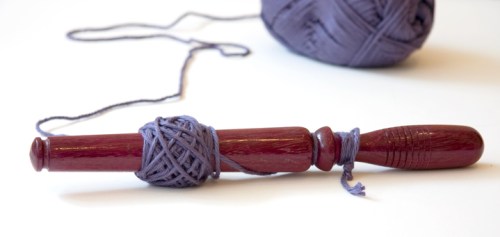
The word “bennystan” is perhaps the most economic translation I’ve done so far, corresponding to “tangle of chitin and bone.” The problem here was that “chitin” does have a correspondent in Swedish but it’s not a well-known word, and writing it out would just be naming an obscure chemical and hoping the audience is familiar with it. The word nystan doesn’t show up on its own very much, and when it does it’s usually a shortened form of garnnystan, a ball of yarn. You’ve got the root in English on loan from, I think, Norwegian, in the form of nostepinne:

Image of a nostepinne with yarn.

Image from tricksyknitter.com/nostepinne. This is a tool for creating balls of yarn, somehow.

Replacing yarn with bone in the Swedish both sounds good and evokes a vivid image (by contrast, “ball of bone” sounds just stupid in English). In other terms, you could say that I omitted the specificity of the skeleton types in order to pack a similar but different punch. It’s at the looser end of the translation spectrum but I think it suits – agglutination (jamming words together, especially nouns) is a technique Uel uses a lot and which suits Swedish very well.

I exchanged the word “saccharine” with the word for syrup, which has similar connotations. And we don’t have saccharine as an adjective in Swedish. We do have sachharin the chemical, of course, but I’ve never known anyone to describe the flavour of things with it. This lack does mean that one connotive element is lost in translation: the small percentage of people whose genes allow them to taste the bitterness of saccharin won’t experience the slight dischord that one has to imagine that they feel whenever people describe sweet things (even overly-sweet or falsely sweet things) as “saccharine.”

~

If you feel such dischord, you might have been pushed into an alternate reality, either recently or as a kid. Haven’t yet found anyone who doesn’t feel this dischord about something. It’s entirely possible that this reality of ours is always already alternate, meaning no-one who lives here comes from here. That’s all I can tell you! CHeck back next week, we’re doing Manual Blueshift, a vignette of weird Americana containing my favourite first line of Uel’s ever.