05-May-2016 (poem)
You have to
write things down
while they are
true.
You have to
write things down
while they are
true.
My love is not easy. What love is?
You ask me what love is. What love is
is whatever eating foxglove is.
or, Letting the Rhythm Get Away with Me a Bit
Funeral pyre, funeral pyre, dress this old corpse in its finest attire!
Funeral pyre, funeral pyre, and then set his ugly damn body on fire!
Funeral pyre! Funeral pyre! All the catharsis you’ll ever require!
Funeral pyre! Funeral pyre! You don’t want a zombie apocalypse, sire!
Funeral pyre!!! FUNERAL PYRE!!! Do burn, or the results will be DIRE!!!
FUNERAL PYRE FUNERAL PYRE WHOEVER SAID DEAD MEN DON’T SPEAK IS A LIAR!!!
~
You get the drift. Please join in!
O let me be forever lost! forever
snared in Demonweb, enwyrded, all
strung up in Fate, ordained by she who severs
lifethread if it please her, let me fall!
O let me fall – o Lolth be praised! – in your
black heart, o spider-mother! fanged and beckoning,
please hear my song! I shut the door,
now let us scheme, o there will be a reckoning,
O Lolth be praised! Let darkness shine!
Eternal night of Lolth! Be raised above us,
binding chaos, I kneel at your shrine,
O Demon Queen! o, you who do not love us.
Let the temples of your foes be razed,
O let you reign eternal, Lolth be praised!
~
Above is a sonnet in praise of Lolth, the spider-goddess. It was commissioned by my dear friend Pao, whom you may remember from this untitled guest /2014/03/11/guest-story-pao/, or her story blog: stories.panterdjuret.nu/.
And good news! You too can commission me to write a sonnet for you, for the meagre sum of eight dollars or more! (This one, by the way is meant to be read aloud, like all good praising songs. The form is in fact perfectly consistent with the Shakespearean sonnet (except maybe the lack of pronounced volta). The borrowing of syllables from other lines is intentional, because I believe anapestic substitution is a cop-out. If you commission a poem from me you can decide the topic, how strict it should be, and which sonnet tradition I should lean on, of course.) Please contact me on johannes dot punkt at gmail dot com.
09-sep-2015
I am brushing my lips against
the rough spots
on your soles; I
am shaving your head; the day
when I have kissed
every square inch of your skin
will pass us by unacknowledged.
I’m trying to write this review to sort out my thoughts on the leviathan and a half of a book that is Douglas Hofstadter’s Le Ton Beau de Marot: In Praise of the Music of Language. Here is one of my thoughts. Observe a new symbol make its way into language: it squiggles and squirms and then suddenly it’s everywhere, diluted, like you just stepped on a worm on the pavement. This is not a bad thing nor a good thing, except maybe for the integrity of the worm. It’s just how we process language, you know. A useful image comes into our possession and we paint it everywhere until it only means itself. Hofstadter would like it if I provided an example or two with my generalisation here, because that is the best way he knows to get information across. Very well.
Take sexting, that utterly ridiculous word. Sometime a few years ago some American news channels got their collective breaths caught in their throats by another in their ritualistic series of tantrums about teenagers having sex lives, or preambles thereto. Apparently, teenagers were sending each other erotic messages via cell-phones. Possibly even, and look away now for a while, nude pictures, colloquially known as “nudes.” Texts about sex. Sexts. This word took the US by storm, and when something takes the US by storm, the US takes to the Internet. Especially Twitter. It became a thing to preface your tweets with “sext:” and then say something longing, something horny, or something plain weird (the humour mostly coming from trying to imagine things like “sext: I stuffed your refrigerator with crystals” as a serious mating call). Patricia Lockwood deserves a mention here because her sext poems are amazing, though we have come to expect sexts from her now, so we don’t get them anymore. Her other poetry is equally amazing.
Anyway, likely, people have not actually changed their erotic messaging habits because of this word, but the word has become a thing. What you are referring to now when you preface a statement with “sext:” is this weird tradition, not any actual attempt at passing your statement off as a human version of that bellowing sounds that moose make when they’re in heat. Or, should I say, that’s what I do. Sometimes I pass through the tradition and come out on the moose-noise side too, though.
Hofstadter’s book is full of translations of one particular French poem. Some of them are pretty good and get the message across very smoothly. But somewhere along the line, he just looses it. The translations start to be based on new challenges on top of the translation challenge, because the translators (most of them being Hofstadter himself) feel like they have mastered the art of translating this one particular poem from French into English. How many enjambments can we stuff into the poem? Can we change the genders expressed? Can we change the rhythm? Hofstadter has very rigid ideas but demonstrates and admits that he doesn’t know quite where his stiffness comes from. I could see where it was going, though, when a translation that reads “… Has some bug / Laid you up? / Made you up- / chuck a lot? / Knuckle not / Under, but …” shows up somewhere in the middle of the tome. (That is also the sequence of lines quoted in the only other review of this book I’ve read, and I feel bad about that, but oh well. Take it as a sign that this particular line was particularly egregious.) That is not a good translation of the Marot poem, but he is very proud of it. I will get back to that. Essentially, there comes a point in the book where the only way to appreciate the poems he shows us is by having read all the other poems, and had the French original explained to us in painfully clear language. At the end of this particular trainwreck of thought is a lipogrammatic explanation of John Searle’s Chinese Room Experiment written in the format of the original Marot poem, and Hofstadter has the audacity to call it a translation. Gasp.
A Cubical Kubrickal Rubrical
The structure of the book is this: I’m at this family gathering. I am fourteen years old, I would perhaps rather be out talking to my older, cooler cousins, but I’m listening to my uncle talk and he never shuts up. I don’t know which side of the family he’s from. Maybe he just barged in here. He talks about anything, everything, occasionally says incredibly racist things without realizing it. (At one point, he compares the Israeli government to the Nazi regime, not based on things they do that are actually genocidal but based on their fucking attitude to language, which is shared by the Academie Française and countless other institutions, but he doesn’t find the symmetry of comparing the French or the Icelandic to Nazis funny so he doesn’t mention those. At another point, he recounts an anecdote about a tribesman asking questions of an anthropologist, and because he’s a tribesman, Hofstadter calls him naïve and laughs at him, even though what he did in the unsourced anecdote sounds more like sarcasm (to me). But I digress. Hofstadter deplores racism where he can see it.) Mostly he comes back to two topics: his dead wife and the translation of poetry. And he gets drunker and drunker, avuncularer and avuncularer. The bits about his wife are very touching, and she sounds like she was a wonderful person, and I am sorry for his loss. I wish he would shut up about the translation of poetry, though. I’ve structured this review like it’s a bit of his book, because, well, why not. Nothing has meaning, it just repeats until it can reference itself. And then it does that until there are two factions: those who are smug about it, and those who are smug about having fun. No-one has fun.
Tous grêlent le nuage incandescent
One of Hofstadter’s main rigidities is that he doesn’t think poetry is poetry unless it’s the very metrical and rhyming things that you can imagine wouldn’t trouble a troubadour. He respects form very much. He doesn’t understand that with the millions of young men who marched right into death in the First World War, the authority of the old form completely disappeared. He doesn’t realize that the war poets faltered the more they were shot at, lost the grip on rhyme schemes the more they died. Near the end of his life – he could not know but he suspected his luck was running out – Wilfred Owen wrote a poem rhyming with consonant clusters more than the fullness preferred by, say, Alfred Lord Tennyson. Here’s the first stanza:
Let the boy try along this bayonet-blade
How cold steel is, and keen with hunger of blood;
Blue with all malice, like a madman’s flash;
And thinly drawn with famishing for flesh.
– Wilfred Owen, from “Arms and the Boy” (1918)
I mean, that’s just one poem. He kept trying to rhyme until the end, for certain. His sonnets were breaking down. He kept being ordered to shoot. Hofstadter doesn’t know this. Hofstadter thinks poetry should be beautiful, should concern only love or grief or scenery, more or less. To him it shouldn’t be about cruelty, shouldn’t be rooted in its time but rather you should easily be able to shovel it up and move it elsewhere, like a factory of bonsai gardens.
Another rigidity of Hofstadter’s is that only native speakers can translate poetry. As evidence for this, he at one point offers up his graceless “Knuckle not / under but”let in the middle of one translation, saying he has a hard time imagining a non-native speaker wielding language so skillfully as he has done right there. Take it in. Don’t take too much of it in, though, for your own good. That’s graceless gunk right there, honestly. Hofstadter also translates a poem into French at one point, probably because he contains multitudes or some shit.
私はGoogle翻訳に「Googleの翻訳」と「日本の「ヒット型付け
Another thing Hofstadter talks a lot about is artificial intelligence, especially the machines’ use of language. This book has taught me why the Chinese Room Experiment is silly. For which, thanks, I guess. I already knew it was silly, but now I can dismiss it with reason. The thing about machine translation that Hofstadter brings up but doesn’t really explore is that it all rests on the immense weight carried by the human translators that came before. That metaphor was inconsistent on purpose. I see no way that machine translation as it exists today or in the next hundred years can learn to do more than repeat things that old translators have said before. Perhaps this is a failure of imagination on my part, similar to the failure which Hofstadter accuses John Searle of imagining, but still.
As a tangent, Google Translate – what seems to be the best thing out there – still uses English as an intermediary language between other languages, almost as if they are deliberately making machine translation seem unappealing. I think you have to teach machines to think before you can teach them to speak, and teach them to speak before you can teach them to write, and then to translate. I don’t think anyone is really trying to teach machines to think. I doubt you can teach the bloody things to dream before you can teach them to sleep.
En underrubrik på svenska. De betyder ingenting ändå
What also becomes clear from reading the book is that Hofstadter considers translation to be an equally creative endeavour as is writing at all. Sometimes translation requires even more ingenuity, he almost says.
The combination of the last of his rigidities up there, that you can only translate into your native language, and the thing he traipses around but wants to say here, that translation is extremely creative, is this: Hofstadter thinks that you can’t write poetry in a language you did not grow up speaking. This is not a bad book, but don’t take it as an authority on anything except maybe artificial intelligence, the things that Hofstadter has actually worked on.
I like form. I write rhyming poetry when the mood strikes me. I attempt grace. Hofstadter makes me want to write ugly poetry.
Writing shit about new snow
for the rich
is not art.
– Issa (trans. Robert Hass)
Three trees that fall from the sky: confetti, propaganda, burning paper wings.
Triad written by me and Rob Mitchelmore (@kerastion).
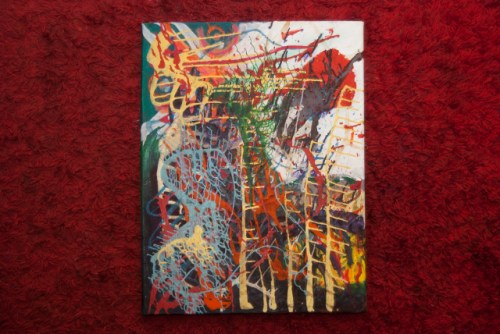
Art by Andreas Porss, photo by Cecilia Hellström.
My good friend Mr. Porss, of andreasporss.wordpress.com, gave me a painting and in return I have written him a poem. Decades from now, art historians and literary historians will uncover this post, printed out and tattered, and they will wonder about the past. Did we really wrestle octopodes together in Cyprus, in an underground and very sexy establishment? Is it true that we invented the pizza salad? What is it with swordfish? None of these questions are answered, or even brought up, in the following poem.
To a Pervert
I know your heart is not some cunt heart
To sheathe a sword in; your young blunt heart
Still sizzling the teflon wok pan:
I cannot eat out your undone heart.
So eat! Eat your own damn heart out, man,
At least feast your eyes. My unwrung heart
Plays Prisoner’s Dilemma, cut-throat,
No Nash equilibrium, some heart.
So shove a microphone down your throat
And learn to speak from your unstrung heart,
But hearts make poor cufflinks, rough red sand
On those you greet, mess, with but one heart
You’d say, today I wanked with this hand.
Today I’m ribs and spine, lung, lung, heart.
Be softer yet, wrap silk round your unspun heart;
And give away your well-hung punk heart.
This is just a quick note to let you know that yesterday, two of my poems were published by Vagabond City Journal. Perhaps you did not know I wrote poetry! What a pleasant surprise for you, then.
You can read them here: vagabondcityjournal.wordpress.com/2015/04/16/2-poems-johannes-punkt/
 Johannes Punkt’s Flaskpost