Johannes Punkt’s Flaskpost

You may be required to show proof of id.

Tag: short stories

Stoplight Conversation

You meet a child who knows what you’re thinking. The walk-light has just gone red.

“Have we met before?” you say. “Are you lost?”

“Yes, and no. To both questions. You’re confused now, a bit alarmed. You’re trying to think about anything but That Thing, but you’re circling the topic so narrowly that I can see the shape of it in your mind.”

You look away.

“That’s a naughty word.”

“I want you to–”

“–stop doing that.” The child sighs. “Yes, I know. You needn’t think such mean things about me, you know. It’s not like I can help it.”

Murder

I have been spending a lot of time on my own lately; I want to be accused of your murder. I can see that you are about to crack and in my greed I want to be the prime suspect. I have been watching television, but only reruns. I have been reading books. When the officers in blue knock on my door I will express shock that is not quite right, and I will have no alibi. They will point to your lousy suicide note and say they have never seen a worse forgery. Yes, this is what I want.

Rock-dust

Image courtesy of The Thrusting Sensations

Image courtesy of The Thrusting Sensations, who have a facebook page: facebook.com/ThrustingSensations, and a website: thrustingsensations.co.uk

Rock-dust litters the streets of a city on the same latitude as Rome and the Gobi Desert. Abandoned cars are parked in great clots; the cars are all identical. They are big and silver and they are family cars, and one or more children have jumped out of these cars to join the children of the city. On the ground, small dust-particles are carried away by stray crenellations of spilt water or gasoline; the smallest particles are still hanging in the air, and there is the bustle of a town busy creating more of them, a distant clink of metal against rock, metal against rock, metal against rock again.

It is the children who carve the stones, and it must have been they who brought all the stones into the city in the first place, from the surrounding forest. There must be dormant stones there, and trees that bend out of the way when the boulders come rolling. The trees, then, root themselves back firmly into the ground.

At first it was just one stone. There is a picture floating around from that first morning, with an angry and incredulous woman pressing her useless hands against a 50-tonne rock standing in her driveway, between her car and the street. She lifts herself from the ground with her efforts, and the rock remains, violently, perfectly still. The next morning, three more stones neatly and deliberately prohibited anyone from leaving that whole street by car. The working adults of that neighbourhood had dressed in their work clothes and simply commuted that day and the next, but the following morning there was a stone guarding every bus stop in a mile-wide radius. At this point, the stones were mostly jagged and pyramidal, cut-off but smooth, as if broken off a very long time ago from a larger structure.

Some of the stones have cracks in them clean through, after tired frustrated and tiny hands making mistakes. While a stone is still being carved, children will crawl all over it, chipping away at select chunks of stone in concert. Other children hammer large pieces of rock that fall off into rock-dust; they wear paper masks over their faces for this.

The children carve faces into these stones, or, they carve one face into them: a round, masculine face with a large nose, and full lips, and hollows for eyes. It is as if they all know this man and capture him in different moods, with a caricaturistic flair added to give the stone life. But whether seething, serene, smirking or sulking – it is the same face. One of the larger stones depicts this unidentified male, his mouth set into a firm line and one shoulder raised from the asphalt, as though he is rising from the middle of the street as a man coming out of the water. The white painted line in the middle of the road goes right through his neck.

There are still cars coming through the city, though their main arteries are blocked, and they inch along on capillary systems and on novel routes. One citizen has opened her garage and knocked out the back wall to let people through. There is a passage in the North of the city where two stone faces stare at each other and any driver must slow to a crawl to pass through, their car’s wing mirrors folded back like the ears of a frightened animal.

Forest is being cleared in two sweeping arches; the highway is projected to be finished by early next spring.
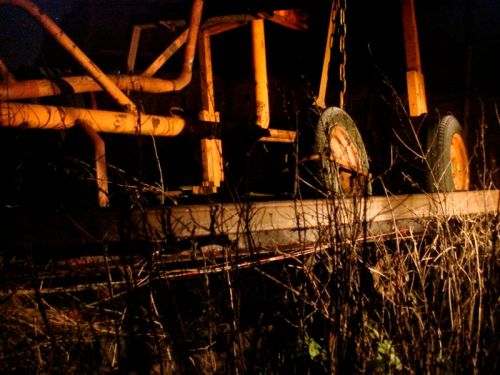
bit by bit by bit

Her first epiphany was in the bathroom, when she caught her naked reflection in the mirror: There is someone else inside of me.

Her second one came shortly afterwards; she forgot which one of the marmalades in the fridge was hers. She used to know: I am in this body, so is someone else. There might be more.

The third came when she stuttered out the first name that came to mind (after a two-second pause) when she introduced herself at the interview. Amanda: I am inside of someone else’s me.

Bit by bit by bit, she realized herself away.

~ Read the rest of this entry »

Noise

There is an empty bedroom and a trail of dropped blankets, teddy bears and stuffed dolls leading out through the door, which is ajar, into the living room. The trail disappears but is taken over by footprints. The TV is on, hissing static and snow into the room like an open window in a storm. The tiny sole-marks are almost oversnowed now, but there is another, larger, set of prints around them. Both sets lead into the machine. There is a thick rope, too, tied to one of the legs of the marble coffee table. It is stretched taut now.

Interest

The men from the bank are here at the door, I let them in, it is freezing outside. There is so much snow that my view of their car must have been obscured for the entire street seemed empty.

They have been observing you, insomniac, they say. You’ve been racking up quite the sleep debt, they say. I don’t understand them.

I try to shake their hands, but they refuse politely.

You come down the stairs a bit like a zombie, Atlantis eyes sunk deep into your skull. They present you the figures; you understand, you say, you fall asleep.

Oubliette

The first thing he forgot was his own name. At first, this pleased him; it was probably a bad name, like Yosef or Stephen or Muriel. But the name-thing gnawed at the back of his hair, and he had all the time in the world. He started making a list in the ground (it was all coarse fibres; there should be a name for that). Sometimes he would start over if he had a really good idea on how to organise it. One day, he grew tired of scratching symbols in the down, and he dropped his symbol-maker, and he

Test Tube

Born from a test tube all splayed out like an autopsied rabbit, I have to invent my own reasons for curling into a ball when I’m crying. It is what people do, I have seen them, and I want to be like you. Sometimes my skin hardens and and I think I will stay like this forever, until it all leathers and cracks open, and I eclose with my new skin glowing red. Sometimes, I stay there for hours, rocking like a dropped porcelain doll, trying to associate this all with warmth and the opposite of dread, whatever that is.

Underground

Be sure to know who you are, when you are commuting. Remember your name distinctly. It is perilous to be pressed up so close to other humans’ identities and waver, because you might lose yourself in the sea of people and, in a fit of sheer panic, grab someone else’s self to hold close to your chest. Do not drift; do not daydream at all. Packed tight like mackerels, everyone swinging this way and that a fraction of a second after the train turns slightly, it is easy to feel a sense of proletarian unity. Don’t. You might lose yourself.

Unforgivable

One day, without warning, I put a lit cigarette into her eye. The air is perfectly immobile and the only sounds are the sizzle from the cigarette, and a half-swallowed cry far back in her throat.

I stop smoking and I pack my bags to go far away, but my train ticket disappears.

“I want you to stay,” she says.

“What if I hurt you again?”

“Do you plan to?”

“No, that is why I’m leaving.”

“So stay. Unless your guilt is more important to you than my feelings. I forgive you.”

She loves me just as playfully as before.