Johannes Punkt’s Flaskpost

You may be required to show proof of id.

NORTH OF REALITY TRANSLATION PROJECT: THE HYPERHEART

Good evening, dear readers! Step into my abode, hang up your skin on the rack but feel free to keep your shoes on. Today’s story is The Hyperheart. Translation notes, in English, can as always be found at the bottom of the post. You can find all the entries in this project at this link: /tag/the-north-of-reality-translation-project/

~

NORR OM VERKLIGHETEN: HYPERHJÄRTAT
    av Uel Aramchek
        översättning: Johannes Punkt

Det första du märker när du kommer in på klubben är närvaron av hundratals ultravioletta eldflugor som alla signalerar i takt med en avgrundsdjup bas. Portvakten stirrar med förväntan på dig och håller fram en burk full av genomskinlig vätska. Du härmar de framför dig i kön och sträcker in handen i ditt eget bröst för att ta ut ditt hjärta.

Det ser annorlunda ut än vad du föreställt dig. I dina händer är det en pulserande kub som glöder karmosinrött utan klaffar eller rörledningar. Dess puls är hög, för det är fortfarande ditt hjärta, och du är rädd. Trots det släpper du taget och låter det sjunka ned i den underliga krämen. Någon knuffar fram dig medan flaskan korkas och du lyckas inte ta emot din nummerbricka. Folkklungan är tät och det finns ingen återvändo.

Du följer spiralmolnet eldflugor ned till källaren, en tiovåningsfärd som slutar i en virvel av kroppar utan hjärtan. Alla dansar i krets runt samma massiva polygonkluster, en dånande struktur som kallas Hyperhjärtat. Dess musik är blod som genomsyrar dig, och genom det kan du känna ett otal andra människors rörelser och passioner sprudla ut ur dina nerver.

När det är dags att gå därifrån finns det hjärta du minns dock inte att hitta i någon av deras burkar. Det bästa de kan göra för dig är att erbjuda dig ett ifrån hittegods.

~

Notes

One translation principle I try to adhere to is to keep the source language as much as possible out of the target language. It is no secret that anglicisms are mushrooming into the Swedish language from the soil of language itself, and I welcome this. My own conversational Swedish is scattershot with anglicisms and expressions from whatever other language I’ve just been trying to speak in, but in writing I like the rather nuked style of John Ajvide-Lindqvist, who writes with almost zero anglicisms. I don’t know if he speaks English all that well, that might have something to do with it. (Language is, after all, just the name for thousands of idiolects.)

It’s hard to judge how much of my own experience with anglicisms comes across to other people as something Swedes would obviously say or if it would seem a translator’s cop-out. Often, drawing attention to the fact that the thing you’re reading is translated is a bad idea, so I’ve put up a membrane between the two languages. Anything that comes through it unchanged is scrutinised and picked apart. If it doesn’t have a long-ish history of being used in this form in Swedish, it gets reworked. This is why I’ve gone with ultraviolett instead of blacklight. Everyone would understand blacklight-eldflugor or the like but it would sound like a cop-out. Calling them ultra-violet is less specific than a blacklight, but the context of the club already being given, it’d be difficult to get the wrong vibe from that phrasure.

The phrase “a source of bass somewhere deep below” became “en avgrundsdjup bas,” “a bass as deep as the abyss,” because all my attempts at fitting the word for source in there sounded very unnatural, also because I enjoy the pun. It’s not the literal meaning, but I deliberated on it and decided that a) the connotations of “somewhere deep below” are more important than saying exactly where the bass comes from, and b) the bass will be mostly felt through the feet and up anyway, and in the chest like a replacement heartbeat, and it’s hard to pinpoint a source of bass anyway.

The word “fountainworks” is surprisingly bothersome. The word I want to use for it is “rörverk” which should be “pipeworks” according to my sensible language use, but seems to only ever have been used to denote factories for pipe manufacture before. After some thought I went with “rörledningar,” which is “piping.” It sounds a tad more like machinery than Uel’s original phrasing, but within the margins, I’d say.

The last challenge with this piece was the word “ambient,” which is also one of those words that people will understand, because we just say ambient musik for ambient music as far as I can tell, but I feel bad about keeping it that way. Also, the word loses all its connotations in tunneling through the membrane. I picked “blod som genomsyrar dig,” “blood which permeates you,” where genomsyra has connotations of both burning acid and deep meditation.
NORTH OF REALITY TRANSLATION PROJECT: SCARECROW ANATOMY

Welcome back to the North of Reality Translation project! Before this week’s post, I’d like to point y’all’s attention at Uel’s Patreon: patreon.com/uelaramchek?ty=h. If you’re reading this you’re probably aware but I’m reminding you anyway, he’s doing a thing called cryptofiction, meaning you pay to receive secret works of fiction that no-one else will get to read. This will be the only chance ever to read these secret fictions. The cutoff point for the first one is just in a few days, the 15th of February. This is really very exciting, we’ll get access to literature that basically no-one else will see, like if Max Brod had kept his promise, and Kafka was still alive somehow. Okay, that analogy ran away from me pretty quickly.

The point is, if you like these fictions, do sign up for the patreon. You’ll get an envelope containing a new secret thing each month. Who doesn’t love secrets?

Today’s story is Scarecrow Anatomy. Translation notes, in English, can be found at the bottom of the post. You can find all the entries in this project — eventually around thirty total — at this link: /tag/the-north-of-reality-translation-project/

~

NORR OM VERKLIGHETEN: FÅGELSKRÄMMEANATOMI
    av Uel Aramchek
        översättning: Johannes Punkt

Konsten att bygga en välfungerande fågelskrämma är sedan länge bortglömd. De flesta som syns i dagsläget är bara bulvaner som av sin egen kraft varken jagar fasan eller spelar mandolin som sina företrädare. Medeltida bönder kände väl till processen av att bygga någonting självgående från vegetabiliskt material, men vad som behövdes fördes nästan alltid vidare genom muntlig tradition och inget annat, och har således gått förlorat.

Återfunna sidor ifrån 1812 års Then förbjudna Almanack beskriver flera delar av den här processen i detalj. En fullkomlig anatomi konstrueras av grönsaker lagrade inuti fågelskrämmans magparti. En ensam aubergin blir i regel levern, medan längder av ihålig majs binds ihop för att bli tarmarna. Så väcks fågelskrämmans organ till liv i samband med att floran inuti börjar ruttna, och med det tillbringar de sina sju till tretton dagars liv i ständig förmultning.

Den skenbara medvetenhet sådana skrämmor uppnår skulle kunna vara ett epifenomen av bakteriekulturen som långsamt förtär deras kroppar från insidan. Somliga har föreslagit att en slags elementär kod ristas in i grönsaksköttet, likt det Emet som aktiverar en golem, och att detta språk kompileras naturligt i fermentering. Utan ett fungerande exempel kan dock ingen av dessa teorier beprövas.

~

Notes

As I read through this in preparation for translating, I thought, “Finally! I know all the words here, and they should be no trouble to translate.” This was not exactly true, but mostly. The phrase “lost to time” kind of stumped me a while, and in the end I went with something that does not include the word for time: “har … gått förlorat,” which means something like “has been lost,” although the verb is go, not be. The words decoy and decay lose their consonance in translation, which is a shame, but the best word I could find for decoy was bulvan, which is very satisfying. It evokes courtroom dealings and fake birds, so I think the aura around it is preserved quite well.

I translated some nouns into vague noun phrases with specifying post-modifiers, such as requirement becoming vad som behövdes (“what was needed”), and automaton into någonting självgående (“something that functions/walks by itself”). In last week’s translation I’d translated automaton into robot (… well, “robot”), but that did not sit right here where nothing, ah, mechanical was described. The vagueness of these phrases fits, in my meaning, with the sense that most of this information is lost.

“The Forbidden Almanac” became the archaic-sounding “Then förbjudna Almanack,” echoing old publications like Then Swänska Argus. I capitalised Emet because that’s how I’ve seen Hebrew words in isotranslation dealt with before. All in all, this was not super challenging to translate but quite satisfying.

NORTH OF REALITY TRANSLATION PROJECT: SELF-TUGGING MARIONETTE STRINGS

Good evening! This project can begin for real! A quick note about the versions of the story that I’m using: Uel has begun putting up polished and edited versions of these stories over at northofreality.com/, so it may well be that the versions of the stories I’ve translated will all be outdated by the time you read this some time in the future. It has already happened with The Flintlock Brain, but Uel’s been gracious enough to add the previous versions of the stories in the comments on his site, so you can always see the version I’m translating from, which is the first one.

Expect one of these posts a week, on Tuesdays, unless I forget. In which case remind me. Or assume me dead. Whichever feels more dramatic to you.

Today’s story is Self-Tugging Marionette Strings. Translation notes, in English, can be found at the bottom of the post. You can find all the entries in this project — eventually around thirty total — at this link: /tag/the-north-of-reality-translation-project/

~

NORR OM VERKLIGHETEN: MARIONETTFILAMENT
    av Uel Aramchek
        översättning: Johannes Punkt

Marionettrådar som drar i sig själva är vad som tillåter halmdockeandroiderna att röra sig och tänka självständigt. Androiderna stoppas med halm som agerar timglassand, då mer och mer faller ur dem ju hetskare trådarnas ryck blir. Filamenten kommer från en mängd olika källor förlänade med livskraft, från brustna metrev till cellostråkar. Trots att dessa är helt statiska när de är för sig själva börjar de vrida och vända på sig när de väl knutits fast vid varandra.

Varje fiber bär med sig en ouppfylld längtan eller lystnad som uppenbarar sig i formen av latent spänning. Så snart dessa strängar är sammantvinnade börjar de söka efter en omöjlig känslobalans, vilket förlänar dem en slags livshärmande rastlöshet. När tillräckligt många trådar har virats runt androidens skelett stabiliserar de sig till en komplex och enhetlig varelse.

En sådan robot håller dock inte länge, då dess första begär är att skingra den spänning som håller ihop den. Den upplever denna livsenergi som en allgenomträngande klåda. I dess frenetiska försök att upplösa denna klåda – genom att slita ut rullarna tråd i sina egna ryggkotor – slår den gnistor omkring sig. Detta sker i regel efter bara några timmars medvetenhet.

~

Notes

I changed the title because the full first noun phrase was a bit too much and didn’t pack any sort of punch as a title in Swedish. I also hemmed and hawed a bit about whether to keep the “self” in the translation of self-awareness but decided against it because självmedvetenhet sounds more like it means self-consciousness. I think it can be both; the details are hazy.

But the major difficulty with recreating this one lies in the neologism “effigetic.” In the first draft I called the effigetic androids faraoniska dödsmaskandroider – back-translated into “pharaonic death-mask androids” – because I was envisioning as the primary image that of stone slabs with people’s faces on them, and funereal respect. It didn’t feel entirely right, so I highligted it and kept on working. Then I realised that what felt wrong about it was that the effigetics here are those of burning someone in effigy, this political, angry thing. You want to watch someone tear themselves apart, of course.

What can be done about that? We don’t exactly burn people in effigy here, that I can find at least, and so we haven’t got a vivid phrase for it. We did burn witches on the stakes, and we burn a giant straw goat in increasingly convoluted ways every winter in Gävle (seriously. Look it up – most recently the goat survived Christmas Eve but did not live to see the new year). Maybe I could make the androids strawmen? If so, I would maybe have to change the self-destruction mechanism, turn it into self-immolation. This adding of details would also require some finessing in the sentences, because as they are written in the original every detail is important and follows lucidly from the previous.

Dare I do this? Yes, of course, I have no scruples. (This is not true; I have too many scruples and can’t ever decide which ones to wear.) Also, I feel that stuffing an android with straw like a scarecrow fits well with Uel’s worldbuilding. But maybe this will come back and haunt me in later translations of effigetics.

Interestingly, in googling for specific words to make sure the words I used were in their right contexts, and in discussing this translation with others, James Joyce and the 2012 translation of Ulysses into Swedish showed up an alarming number of times.

Digitalis

My love is not easy. What love is?
You ask me what love is. What love is
is whatever eating foxglove is.

Stray Translation Notes: “Soundbite”

So, I say, which I think is the best way to start a sentence/paragraph/text/&c. So — I am writing a lot of translation notes at the moment. And I’m also translating a lot of things for which I do not need to write down notes, but sometimes I write down notes anyway. It’s a good way to think. I’m editing a story I wrote, and the best most circuitous and frustrating but resultative way to edit a text is to translate it back and forth and compare versions, at least for me. A good thing about this process is that the translation becomes much freer because I can change both source text and translation all the time. (Often this means that I am tempted to rewrite a sentence to avoid a translation problem, but I don’t do that unless the new sentence is prettier/better.) So why am I telling you this?

I’m having a Problem and I thought I’d type it all out to see if I can figure it out. I met a man the other day who spoke like a Shakespeare character in that nothing seemed to occur to him if he didn’t say it out loud. It was a bit sad perhaps. Anyway, in the xth draft — English — there is suddenly the word soundbite (usually spelt sound bite, I know, but I make the rules here). It was not in the previous draft. It poses a problem because that word does not exist in Swedish. I use it a fair amount but I tend just to say “sound bite,” you see. In many contexts you can replace it by phrasures like innehållslösa ord (contentless words), ord folk bara upprepar i medier (words people simply repeat in the media), or uttalanden (statements), but in this context what I want is the slightly more technical definition that sound editing, like the statement is part of a longer speech, a summation about which one can find out more were one so inclined. Nevermind that nowadays speeches are made up of soundbites entirely, like reading out a listicle speech. A speechsticle. Nevermind that soundbites have shrunk from over half a minute to just a few seconds over the long term of the faithful radio apparatus.

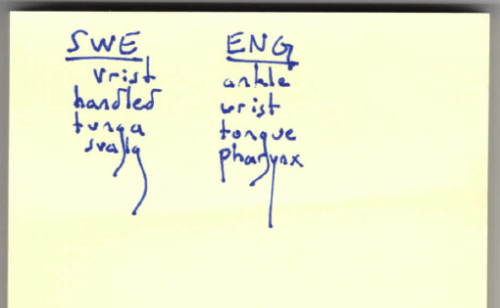
I need the word for how it means all of the things I’ve brought up and more. The reason I want this specific definition/connotation is simply that it’s part of my background, it is how I talk. The story will be much less me if I don’t find a way to connote all of this and row it home. So, the important aspects identified so far are: (1) emptiness, (2) partialness, (3) expression (of an opinion or fact, as somewhat a pose), and (4) connection to radio as a medium. I’m ignoring the connection to holding speeches, in fact not counting the politicality as an important aspect at all. One technique that one can use sometimes is to assign connotations to other parts of the sentence or paragraph, if one cannot stuff all the right connotations into a word. Think of it as you would a certain poem; a sonnet perhaps. Sometimes you need to move around ideas, swap ankle for wrist in one place and mouth for pharynx in another. To get the rhythm right without sacrificing the content of ideas.

pstit

I guess this is the part where I tell you the whole sentence that the thing is in. Very well. The raw material of the xth draft is this:

He’d been thinking as he stood there in the aerobics hall – which was, surely, not the most masculine of ways to exercise anyway – of three different conversational topics and a few soundbites to chew through which could perhaps invite more comments and continued the conversation.

In my defence, it is not before the x+1st draft that I pay this close attention to the words on this level and care about grammar. But soft, what a relief. It seems that the verb “chew through” already connotes a kind of emptiness, and that should be easy enough to preserve in translation. Let us then say that the connection to radio as a medium is the most important thing to preserve, in which case we probably want a word like ljudklipp (sound clip?), which goes best with a verb like spela upp, connoting aspect (2) fairly well. We can add aspect (3) in another verb connected with the conversational topics brought up, by making sure the opinions-which-start-conversations do not need to be real things that this character actually believes. And so, I will leave you with the Swedish sentence. This thing will probably never reach print but I will be proud of it. Thank you for reading; it helps to pretend I’m talking to somebody.

När han stod där i aerobicssalen – nog inte den manligaste träningsformen – tänkte han fram tre olika åsikter han kunde ha och spelade upp några ljudklipp i huvudet som han kunde tugga igenom och som, möjligen, skulle locka mer kommentarer och fortsätta samtalet.

A SHORT SCENE

WOMAN
And this is “Silent” Jimmy.

MAN
What, because he’s always quiet?

“SILENT” JIMMY
No in fact it is because I will not stop talking, for example that one time that all of us were drinking beer and someone made the mistake of asking me to define the word “pleasant” and everybody had managed to drink up two more rounds of beer before I finally got to a punctuation mark in my talking. I’m a bit better now of course but still the most commong thing that people tell me is inevitably–”

WOMAN
Silent, Jimmy.

“SILENT” JIMMY
That.

NORTH OF REALITY TRANSLATION PROJECT: THE FLINTLOCK BRAIN

Good day everybody! I’m doing a Project. The Project is this: I am translating a bunch of my favourite stories from Uel Aramchek’s North of Reality: northofreality.com. Roughly thirty of them. Biased toward the earlier archives, because it takes time to process and remember a thing. They will be translated into Swedish. However, most people who read this here blog (it’s like, a text-vlog for those uninitiated) don’t speak my musical mother tongue so this would be incredibly boring for you to read, if not for the fact that there are also translation notes for each story.

I’ve written to you about Uel’s work before: /2015/07/12/how-to-sign-a-contract/! he also helped me figure out what the words mycofreudian and mycojungian mean: /glossary/#mycofreudian

I have received permission from the author to translate these texts, but any crimes committed in the crossing of any forbidden semiotic or semantic fields are entirely on me.

I will post the first one today and the rest sometime early next year when I’ve finished them all, so I can post updates without feeling any sort of stress about this whole business. I recommend reading the whole archive at North of Reality and letting it all soak in your brainmeats, but particularly you should read the stories I’m translating before you read the translation or the annotations. Today’s story is The Flintlock Brain: northofreality.com/tales/2015/5/17/flintlock-brain

~

NORR OM VERKLIGHETEN: FLINTLÅSHJÄRNAN
    av Uel Aramchek
        översättning: Johannes Punkt

En flintlåshjärna, en primitiv sorts artificiell intelligens, finns laddad inuti varje järnmannekäng. Sågspånsgelatin knyts runt koppartråd, vilken i sin tur är täckt med svartkrut. Avfyrningsanordningens hane och eldstål vilar mellan dess två lober, som vanligtvis sitter blottade utanför androidens metalliska huvud.

En enda idé eller känsla är allt vad flintlåshjärnan kan hantera, då den fullkomligt förintas i samma ögonblick som den tänds. Efter ett ursprungligt utbrott av tankeverksamhet förtärs all resterande gelé av eld. Det är allmänt vedertaget att det är omöjligt att veta vad mannekängen tänker på under dess korta liv, men mystikerna som bygger dem hävdar att tanken bestäms av konfigurationen och komplexiteten av de underliggande trådarna.

Moderna androider som har fattat intresse för sina antika bröders liv har börjat konstruera ett eld/el-gränssnitt som ska kunna tolka flintlåshjärnans explosiva synapser från ett säkert avstånd.

~

Notes

I didn’t realize until translating what a nice concoction of connotations the verb “load” carries here. Two of the meanings of the verb translate directly into Swedish; the senses of upload and loaded gun, but the one meaning load up, as in fill something up (a washing machine, ship, or in this case a skull), is lost. On the other hand, some of the relevant meanings of the word “charge” are there.

I had to look up diagrams for what the parts of a flintlock pistol are called, since these words are not common enough to show up in either my large bilingual dictionaries or on services like google-translate.

In several places I had to change word order and articles to make it flow smoothly. There was a lot of opportunity to write long compound words in this one, which I appreciate. I’m a bit uncertain about the translation of interface because it’s not a word I use myself; I’d just say the English word.

The word brethren kind of loses its religious connotations for most readers here, but I’ve at least used the formal and “correct” version of the word, instead of my own dialect. I agonised over this a bit until I realised the difference between brothers and brethren is kind of reflected in the dialect/official difference.

Funeral Pyre

or, Letting the Rhythm Get Away with Me a Bit

     Funeral pyre, funeral pyre, dress this old corpse in its finest attire!
     Funeral pyre, funeral pyre, and then set his ugly damn body on fire!

     Funeral pyre! Funeral pyre! All the catharsis you’ll ever require!
     Funeral pyre! Funeral pyre! You don’t want a zombie apocalypse, sire!

     Funeral pyre!!! FUNERAL PYRE!!! Do burn, or the results will be DIRE!!!
   FUNERAL PYRE FUNERAL PYRE WHOEVER SAID DEAD MEN DON’T SPEAK IS A LIAR!!!

~

You get the drift. Please join in!

A Postcard from Before the Summer

The birds are flying so close to the ground that their wingtips are touching the tallest flowers. I dropped a coin from standing on a chair and it sank into the floor like there had always been a slot for it there. Every light from every window that I pass slopes downwards with a trajectory like a fishing rod instead of something real.

Yours,

Paean

O let me be forever lost! forever
snared in Demonweb, enwyrded, all
strung up in Fate, ordained by she who severs
lifethread if it please her, let me fall!
O let me fall – o Lolth be praised! – in your
black heart, o spider-mother! fanged and beckoning,
please hear my song! I shut the door,
now let us scheme, o there will be a reckoning,
O Lolth be praised! Let darkness shine!
Eternal night of Lolth! Be raised above us,
binding chaos, I kneel at your shrine,
O Demon Queen! o, you who do not love us.
Let the temples of your foes be razed,
O let you reign eternal, Lolth be praised!

~

Above is a sonnet in praise of Lolth, the spider-goddess. It was commissioned by my dear friend Pao, whom you may remember from this untitled guest /2014/03/11/guest-story-pao/, or her story blog: stories.panterdjuret.nu/.

And good news! You too can commission me to write a sonnet for you, for the meagre sum of eight dollars or more! (This one, by the way is meant to be read aloud, like all good praising songs. The form is in fact perfectly consistent with the Shakespearean sonnet (except maybe the lack of pronounced volta). The borrowing of syllables from other lines is intentional, because I believe anapestic substitution is a cop-out. If you commission a poem from me you can decide the topic, how strict it should be, and which sonnet tradition I should lean on, of course.) Please contact me on johannes dot punkt at gmail dot com.